
The basic distinction in mother of pearl vs pearl is what the material name refers to. Mother of pearl, also called nacre, is associated with the inner shell surface of pearl-producing mollusks. A pearl is a gem formed within a mollusk. The two names are not interchangeable, even though most pearls also contain nacre.
For a bracelet buyer, that distinction helps you read the listing. It does not tell you the treatment history, quality, durability, or value of a particular piece. Start with the material name, then compare the complete design and the information supplied for it.
Mother of pearl vs pearl: the basic labels
Mother of pearl describes shell material
A mother-of-pearl label refers to shell material, rather than naming a pearl that formed within the animal. GIA’s review of optical effects in gemstones describes nacre in the inner surfaces of shells of pearl-producing mollusks and in most pearls. That shared material helps explain the related names, but does not make a shell component and a pearl the same object.
Pearl describes the gem
A pearl forms within a mollusk. The word does not require every pearl to have a perfectly round outline, nor does it tell you everything about how an individual pearl was produced or treated. A listing needs additional information to answer those questions.
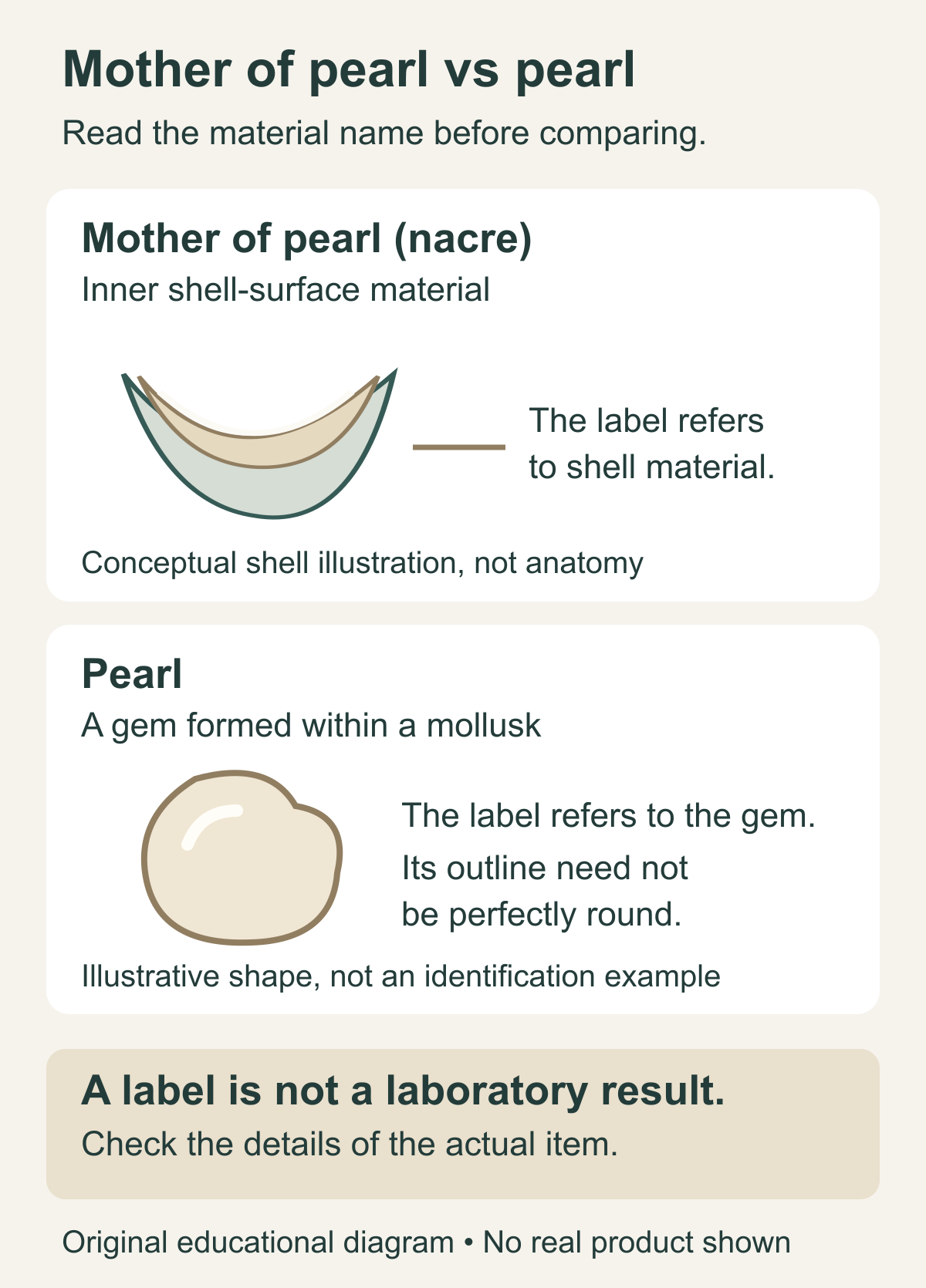
A round bead in a photograph is not enough to decide which label applies. Use the seller’s material description to understand what is being offered, and ask for clarification if the photograph and description seem inconsistent. Neither a picture nor a seller label is a laboratory identification.
Keep material, shape, and other descriptors separate
Several words can appear together in a bracelet listing because they describe different aspects of the piece. Reading each word separately prevents an attractive name from becoming a claim it never actually makes.
- Mother of pearl and pearl identify the basic material distinction discussed here. One is not an alternative name for the other.
- Baroque describes an irregular pearl shape. It is not a synonym for mother of pearl, and it does not by itself identify origin, treatment, or quality.
- Freshwater on a product listing is not enough to establish that particular item’s cultured status, exact shape, treatment history, or grade. Those details need their own disclosure.
- Single strand or double strand describes the bracelet’s construction. It does not authenticate the materials used in either design.
If a detail matters to your purchase, ask about that detail directly. For example, a question about treatments should receive a treatment disclosure, rather than an answer that repeats “freshwater” or describes the bead’s shape.
Compare the complete bracelet design
Material names are most useful when you read them alongside all the other components and the bracelet’s structure. These two listed designs illustrate that buying choice:
A single-strand mixed-material design
The Agarwood, Black Mother-of-Pearl & Obsidian Bracelet is listed with agarwood, black mother-of-pearl, and black obsidian in a single-strand construction. The mother-of-pearl wording applies to one material within that mixture; it should not be read as a claim that the whole bracelet consists of pearls.
A double-strand pearl-and-amethyst design
The Amethyst & Freshwater Pearl Double-Strand Bracelet is listed with amethyst and freshwater pearl. Its material description and double-strand structure offer a different design to consider. The label does not establish laboratory verification, treatment status, a pearl grade, or a specific production method.
Compare the current photographs of the particular pieces to judge the arrangement you prefer, then check the written dimensions and fastening details. Do not assume every mother-of-pearl bracelet looks like the first example, or every pearl bracelet uses the second example’s construction.
Choose by the piece, not a universal winner
The words “mother of pearl” and “pearl” alone cannot tell you which bracelet will be more durable, cost less, or suit you better. The finished construction and the information about the individual item matter. Avoid choosing on an unsupported rule that one material is always the tougher or cheaper option.
For an everyday piece, ask for care instructions that cover the complete bracelet, including its other beads, string, and fittings. Do not transfer a care assumption from a material name to every component. For pearl designs, read how to care for pearl and mixed-material bracelets before choosing a cleaning routine.
Questions to ask before choosing
- Which parts of this exact design are described as mother of pearl or pearl?
- Does the description distinguish materials from shape and strand-count terms?
- Are the measurements, fastening, and construction suitable for how I intend to wear it?
- What is disclosed about treatment or production method, and what remains unspecified?
- What care instructions apply to the complete mixed-material bracelet?
Use those answers to compare the actual pieces. For related material and purchasing questions, browse our bracelet comparisons and buying guides.