
If you want to know how to tell if pearls are real, start with a clear material description and evidence that applies to the item you are buying. Photos, surface observations, and a seller’s label can help you ask better questions, but they cannot by themselves establish pearl identity, natural versus cultured origin, or treatment status.
“Cultured” does not mean imitation, and an irregular shape does not prove that a pearl is natural. For a purchase that depends on documented identity, ask what a qualified professional can establish about the particular piece before relying on a home check.
First separate natural, cultured, and imitation
The word “real” can hide several different questions. Are you asking whether the material is pearl, how the pearl formed, or whether it has been treated? Keep those questions separate.
Natural pearls
Natural pearls form in mollusks without human intervention. “Natural” in this sense describes how the pearl formed. It is not something that a seller’s attractive photo or a small surface irregularity establishes.
Cultured pearls
Cultured pearls grow with human intervention and care. They are pearls, not imitations merely because people helped start or manage their growth. Freshwater cultured pearls are one cultured-pearl category; “freshwater” and “cultured” are not opposites.
Imitation pearls
Imitations are made to resemble pearls. They belong in a different material category from natural and cultured pearls. A clear listing should identify what is being sold rather than leave you to infer the material from appearance.
GIA’s explanation of pearls provides the background for the natural and cultured distinction. That general terminology does not identify an individual bracelet.
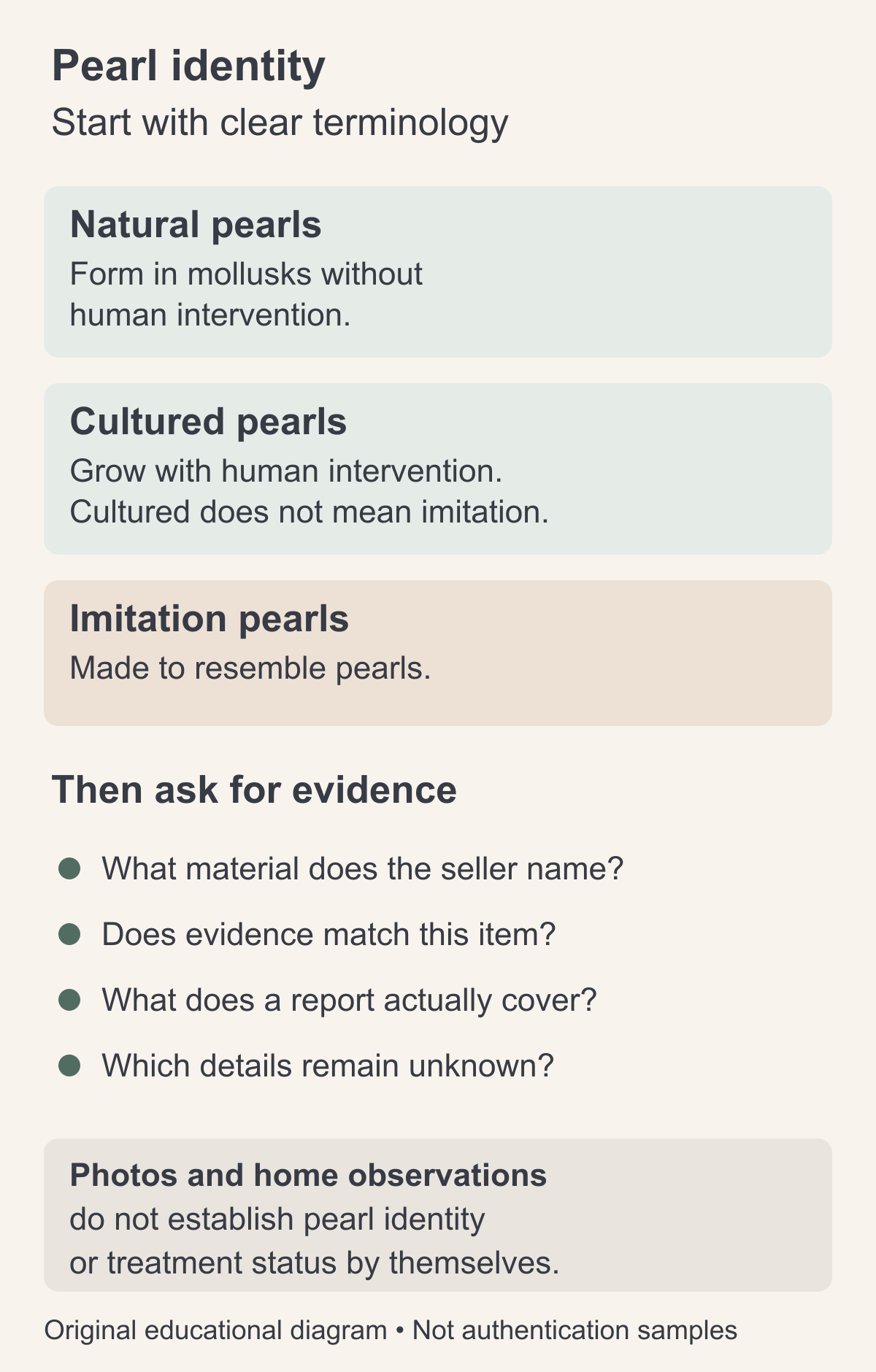
This terminology and evidence checklist explains the questions to ask. It is not a comparison of authenticated pearl samples.
What you can usefully check without testing the material
Review the listing, the seller’s replies, and the piece together. The aim is to spot unanswered questions or a mismatch, not to turn an observation into a verdict.
- Read the exact material wording. Does the description say natural pearl, cultured pearl, imitation, or only use a style term? Ask the seller to explain any ambiguous wording.
- Identify which item the photos show. Ask whether they depict the actual piece you will receive or a representative example. If there are multiple designs or options, confirm the selected one.
- Compare the piece with what was described. Check the arrangement, visible surface condition, and included components. A discrepancy is a reason to contact the seller; matching a photo is not proof of identity.
- Keep the information together. Save the listing and the seller’s material statements so that any later assessment can address the claims actually made.
Pearls can vary in shape, color, and other qualities. A round, smooth-looking bead is not automatically an imitation, and an uneven surface is not a guarantee of authenticity. A photo can show appearance, but it cannot establish every quality factor or reveal all treatment information.
Ask for seller evidence tied to the item
A useful answer explains both the claim and its basis. These questions make that request specific:
- What material are you selling? Ask for the pearl description in writing, including natural or cultured status if that is claimed.
- What is known about treatment? Ask what has been disclosed and what remains unknown. Silence is not evidence that a piece is untreated.
- What supports the description? Ask whether it comes from a supplier’s statement, the seller’s own description, or an assessment of the item. Those are different kinds of evidence.
- Which item does that evidence cover? Check whether it applies to the exact bracelet, selected pearls, a batch, or another example.
- What does any grade mean? If the listing uses “AAA” or a similar label, ask for the seller’s grading criteria rather than assuming every seller uses the same scale.
Pearl quality involves more than one visual feature: size, shape, color, luster, surface, nacre quality, and matching can all matter. Quality language and material identity answer different questions. A seller’s grade should not be treated as an independent laboratory conclusion.
Why tooth tests, scratches, and photos are not a final answer
Do not bite or scrape a pearl to try to prove its identity. A sensation or mark does not give you a documented answer about natural versus cultured origin or treatment. Avoid destructive home tests rather than risking the piece for an uncertain conclusion.
Likewise, a close-up photo is not a laboratory assessment. Surface details may prompt a question, but they do not let you certify a seller’s material claim. If a home check leaves you unsure, keep that uncertainty explicit instead of combining several uncertain observations into a claim of certainty.
How to review a professional report
If a seller supplies a report, start by checking who issued it, what item it describes, and what conclusions it actually states. Ask how the item in the report is linked to the piece being sold. Do not assume that a report about a loose pearl covers every pearl and component in a finished bracelet.
Read the limits as carefully as the conclusion. A description of one characteristic is not automatically a statement about every treatment, origin, grade, or component. If authenticity is central to your purchase, ask the relevant professional whether their assessment can answer your specific question for that item.
Methods, service scope, and report contents need to be confirmed with the provider. This buying checklist does not promise that any one report or laboratory service covers every question.
Apply the same questions to a bracelet listing
The Amethyst & Freshwater Pearl Double-Strand Bracelet is an example of a listing that names more than one material. Its product label is not, by itself, proof that the pearls are natural, cultured, untreated, or of a particular grade. Ask which statements and supporting evidence apply to the selected piece; this guide does not authenticate that product.
Before buying, you should be able to distinguish what the seller claims, what supports it, and what remains unknown. If the answer you need is missing, ask for it or pause the decision. For other material and purchase questions, explore our bracelet authenticity and buying guides.