
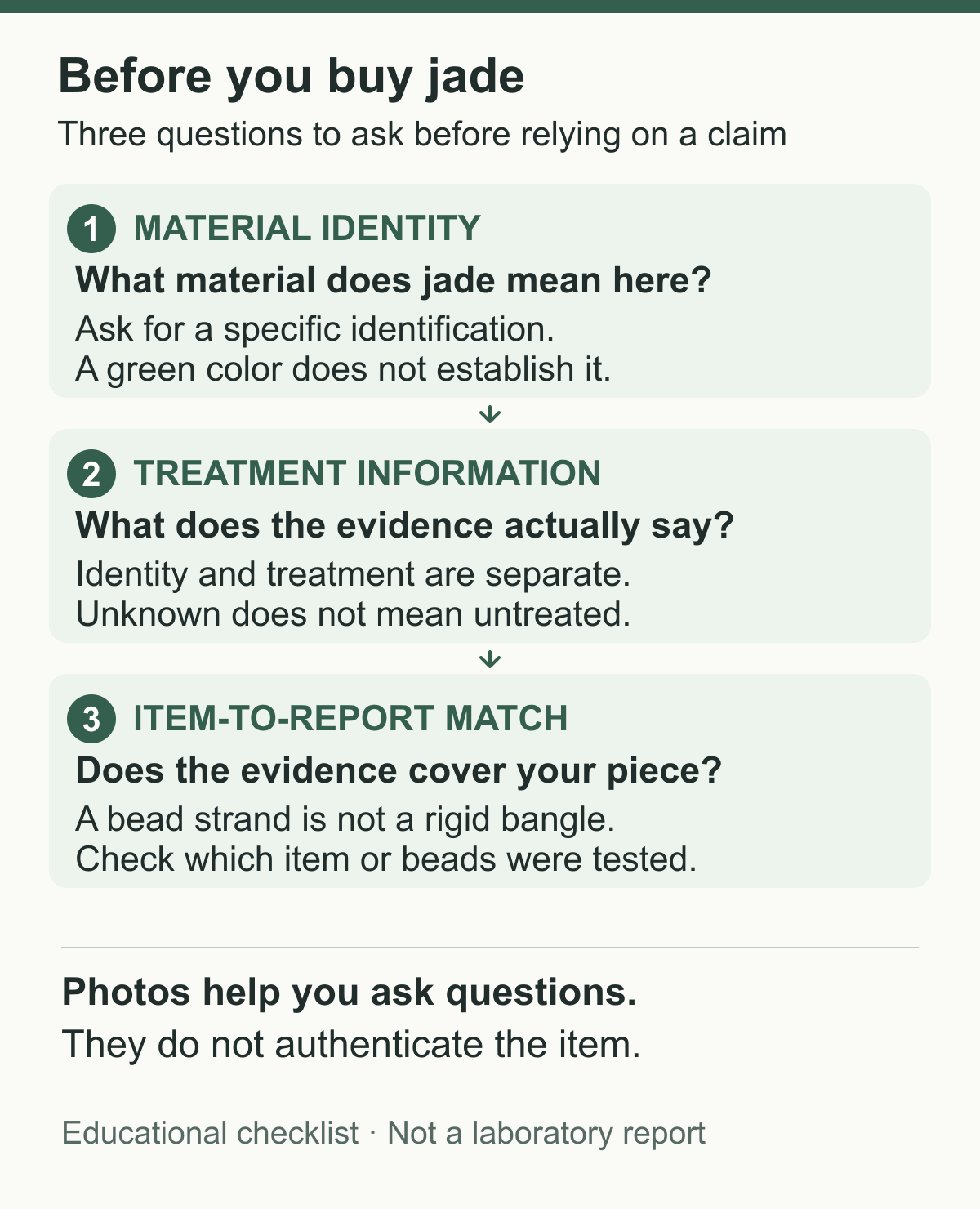
If you are asking how to tell if jade is real, separate two questions: what material the piece contains and whether that material has been treated. A green color, cool feel, ringing sound, seller label, or photograph cannot establish both. The useful route is a precise written description, evidence tied to the actual piece, and qualified examination when the purchase depends on a confirmed identity or treatment status.
A bead bracelet also needs to be assessed as a bead bracelet. Advice demonstrated on a rigid jade bangle does not automatically apply to a strand with many beads, cord, and decorative fittings.
Ask what the seller means by jade
Jade is not the name of just one mineral. The term has long covered jadeite and nephrite. GIA’s material description also includes green omphacite under specified conditions; that qualification should not be dropped when discussing a seller’s label. Identifying an unfamiliar jade-like material can require advanced testing.
A general label therefore leaves a more specific question open. Ask the seller which material is claimed and what supports that identification. Neither the word jade nor an attractive green appearance proves that a bracelet is jadeite or nephrite. Other natural and manufactured materials may resemble jade.
Keep the answer about mineral identity separate from the answer about treatment. Genuine jade material can still raise treatment questions. Conversely, an unknown treatment history is not proof that the material is an imitation.
Treatment is a separate part of the description
Jade materials can be dyed, bleached and impregnated, coated, or otherwise treated. The relevant buyer question is what is known about the particular piece, rather than whether it passes a broad real-versus-fake label.
If a listing uses Type A, Type B, Type C, or a related trade label, ask for its meaning in that listing and the evidence behind it. Do not translate a short label into an absolute untreated claim without checking what the seller and report actually say. This guide does not provide a complete treatment-classification system or a visual method for assigning those categories.
Write down unresolved points. “The material was identified” and “the treatment status was established” are different answers. A report should be read for the conclusions it actually gives, including its limitations.
Why familiar home checks cannot authenticate jade
Coolness and appearance
A cool sensation tells you how the object feels at that moment, not which mineral it is. Color, translucency, surface shine, and marks visible through a phone camera can prompt questions or help describe a piece. They do not independently prove its mineral identity or treatment history.
Sound and the bangle comparison
A ringing sound is not an authentication report. A double-wrap bead bracelet is a different object from a rigid bangle, so copying a demonstration performed on a bangle is particularly unhelpful. Do not knock jewelry against another object to try to obtain a decisive sound.
Scratch and chemical tests
Do not scratch the piece, try to scratch glass, heat it, or apply household chemicals as an identification test. These actions can damage the item or its components while leaving the central questions unresolved. A mark or lack of a mark should not be turned into a material or treatment verdict.
When a claim cannot be settled without examination, stop the home tests and ask a qualified gemologist or laboratory what can be determined from the actual item.
What stronger evidence looks like
Some treatment evidence is beyond an untrained visual inspection. GIA’s discussion of infrared spectroscopy describes the use of infrared analysis for detecting polymer impregnation that may be difficult to recognize by eye. That is an example of why an appropriate examination matters; it is not a promise that one instrument resolves every material and treatment question.
Before relying on a report, check four connections:
- Issuer to document: identify the laboratory and report number. Use the issuer’s own verification service when one is available, rather than relying only on a seller-supplied image.
- Document to object: read the item description and compare any available measurements, weight, photograph, or other identifiers with the piece being sold.
- Object to bracelet: ask whether the examination covers the complete bracelet, selected beads, or a different sample. Do not extend a finding to unexamined beads without a basis.
- Finding to claim: distinguish the material identification from any treatment findings. Ask for an explanation when the seller’s wording is stronger than the report.
A report number that checks out does not, on its own, match the document to the item you will receive. If the description or identifying details do not fit, pause the purchase and have the seller resolve the discrepancy.
Read the description of the bracelet you are considering
The 8mm Jade Double-Wrap Butterfly Bracelet is listed as a Jade bead bracelet in a double-wrap design. It is not a rigid bangle. The 8mm description refers to the beads, not a bangle opening or the bracelet’s inner circumference.
The product name and photos do not establish a specific jade mineral, Type A status, an absence of treatment, or a laboratory report for this item. Ask for evidence if any of those properties is essential to your purchase; do not infer them from the design or label.
A useful message to a seller is:
- Which material is being identified as jade, and what is the basis for that identification?
- What treatment information is known about the bracelet I would receive?
- Can I see the complete report, if available, and understand exactly which item or beads it covers?
- Do the photos show this bracelet or a representative example?
- Can you confirm the material description and applicable return conditions in writing?
No report does not automatically mean imitation. It does mean that a claim requiring independent confirmation remains unconfirmed. If your decision depends on that confirmation, resolve it before purchasing instead of relying on a home check afterward.
Keep authenticity questions separate from meaning and care
A material identification does not establish a spiritual effect, and cultural meaning does not authenticate a gemstone. Our guide to jade bracelet symbolism and care addresses those separate wearing and cultural questions.
Care also depends on the treatment and the complete construction, including cord and fittings. Do not assume that cleaning advice for an untreated loose piece applies to an unknown-treatment bead bracelet. Ask for instructions that match the actual item.
For related material and purchasing questions, browse the bracelet authenticity and buying guides.