
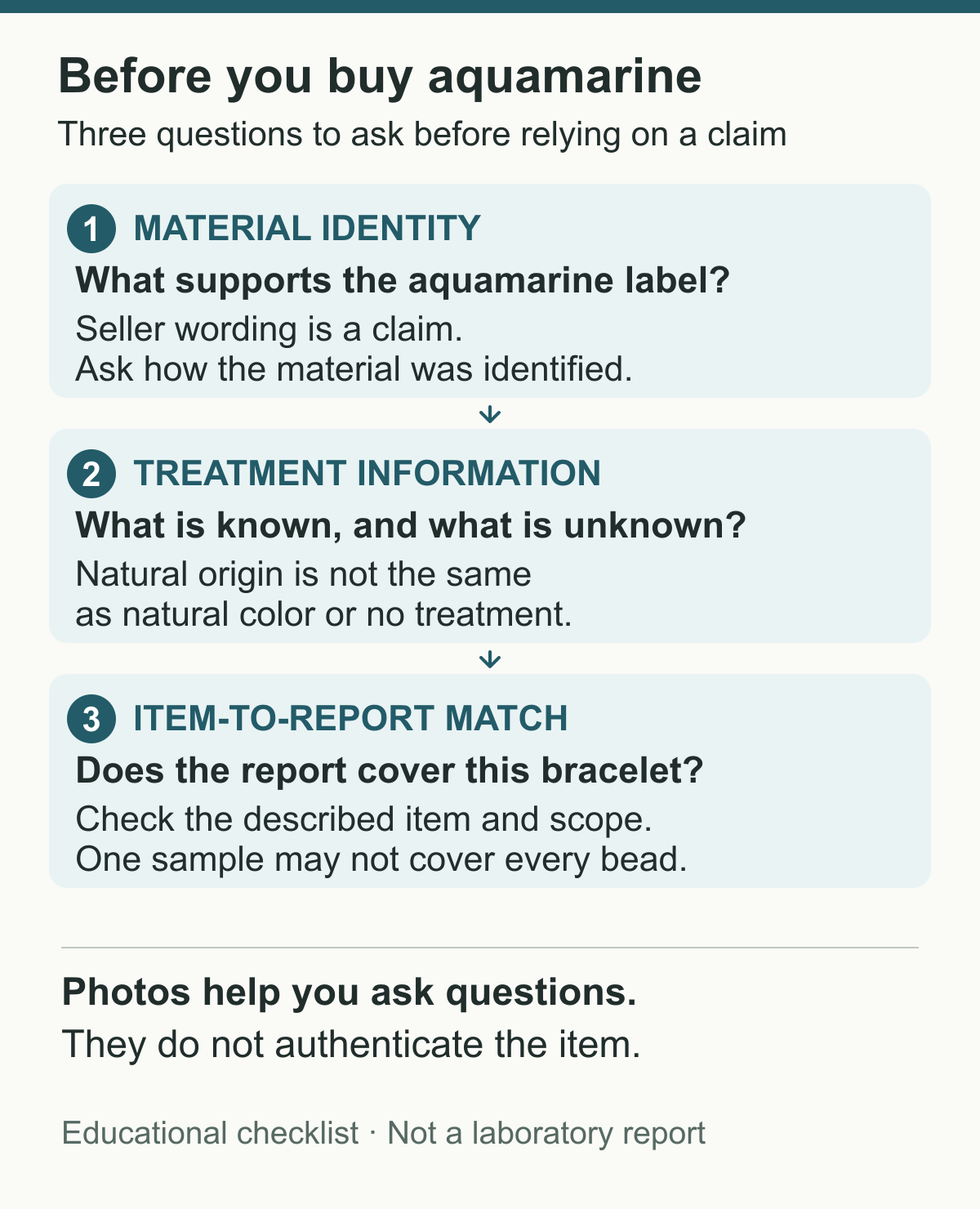
To work out how to tell if aquamarine is real, start with three questions: what material is being sold, what treatments are disclosed, and whether any identification report applies to the bracelet you would receive. Blue color, a seller’s label, or a clear photograph cannot answer all three. A gemological identification can provide stronger evidence, within the scope of the examination.
For a bead bracelet, the practical goal is to connect the seller’s description to the actual beads. You do not need a destructive home test or a checklist that promises certainty from appearance.
Separate material identity from treatment claims
What is the material?
Aquamarine is a variety of beryl. A listing that uses the word aquamarine is making a material claim; it is not itself an independent identification. Ask whether that description comes from the supplier, the seller’s own assessment, or an examination of the item.
If a seller uses natural, ask what that word describes. Natural origin, natural color, and an absence of treatment are separate claims. An answer about one does not settle the others.
What is known about treatment?
Ask specifically what treatment information is available, rather than relying on real or genuine. The answer might be a disclosed treatment, a limited laboratory finding, or simply that the treatment history is unknown. Unknown does not mean untreated.
Do not assume that every treatment, including every instance of heating, can be detected. The useful question is what the particular examination can establish and which limitations remain.
Does the evidence cover this item?
A report for another stone is not a report for the bracelet in your cart. A supplier document may be relevant, but its connection to your item still needs explaining. This is especially important when a product photograph represents a style that can be supplied as several different bracelets.
What photos and home observations can tell you
Use photos to understand the visible design and ask better questions: are there close views of the beads, an image of the whole bracelet, and a clear description of what is included? Ask whether the photographs show the actual item or a representative example.
Color, cloudiness, transparency, and visible marks are observations to discuss with the seller. They are not a reliable yes-or-no test of mineral identity. In particular, neither a very clear bead nor a cloudy one proves that the material is aquamarine. A camera image also cannot establish natural color or an absence of treatment.
Feeling cool, appearing heavy, or resembling another bracelet does not close that evidence gap. Avoid scratching the beads, trying to scratch glass, applying chemicals, or heating the bracelet. A damaging experiment is not a substitute for an identification, and the cord or fittings add further uncertainty.
Read an identification report without asking it to prove too much
The GIA aquamarine buyer’s guide distinguishes identification from quality grading. It explains that GIA does not assign an AAA, AA, or A quality grade to aquamarine; sellers can use their own descriptions. Its identification reports address matters such as identity, natural or laboratory-grown origin, and detectable treatments.
That does not mean every report answers every question. Read the actual result and comments, including any limitation, instead of treating the word certificate as an all-purpose promise.
- Check the issuer. Record the laboratory name and report number. If the issuer offers a verification service, use its official service rather than relying only on the seller’s screenshot.
- Check the described object. Is the document for a loose stone, a bead, several submitted beads, or a finished bracelet? Read its description before applying it to the whole piece.
- Compare available identifiers. Look at the description, measurements, weight, photograph, or other identifying details actually present. Ask the seller to explain a mismatch or an unclear connection.
- Read the scope. Separate the material finding from treatment observations. Do not turn a limited finding into an unsupported untreated or natural-color claim.
A genuine document and a correctly matched item are two different checks. Verifying a report number alone does not establish that the beads being shipped are the beads examined. If only a sample was tested, ask what that sample can support about the rest of the bracelet.
Apply the checklist before buying an aquamarine bracelet
For example, the Aquamarine Bead Bracelet – 8mm gives you a specific listing to review. Its product name and images are not a laboratory report. They do not independently establish natural color, an absence of heating, or a GIA identification for the bracelet.
Before relying on a material claim, send a short request:
- What evidence supports the aquamarine identification for the bracelet I would receive?
- What treatment information is known, and what remains unknown?
- If there is a report, can I see the complete document and understand which item or beads it covers?
- Are these photos of the actual bracelet or an example of the design?
- Can I have the material description and applicable return conditions in writing before ordering?
If a report is unavailable, that alone does not prove the item is an imitation. It does mean you should not purchase as though independent identification has been supplied. If verified identity or a specific treatment status is essential to you, resolve that question before buying or choose an item with suitable evidence.
Common questions about aquamarine authenticity
Does AAA aquamarine mean it has been authenticated?
No. AAA is not a universal aquamarine grade or an identification report. Ask the seller what its grade describes and what separate evidence supports the material claim. Quality guidance for faceted gems should not be turned into an authenticity test for cloudy bracelet beads.
Can a jeweler tell from a photo?
A photo may help a professional decide what to examine or which questions to ask. It does not replace the examination needed to support an identification or treatment conclusion. Ask what can be established from the actual item and whether a laboratory referral is appropriate.
Does an aquamarine identification tell me how to clean the whole bracelet?
Not by itself. Beads, treatments, cord, and metal components can have different care requirements. Ask for instructions for the complete bracelet rather than applying a loose-gem cleaning recommendation to every component.
For other material and purchasing questions, see our bracelet authenticity and buying guides.