
A real tiger eye bracelet cannot be authenticated from one photograph, one color, or a dramatic light band alone. The strongest buying decision combines visible features with a seller’s material description, treatment disclosure, return policy, and—when the value justifies it—an independent gemological opinion.
Tiger eye has recognizable visual traits, but imitations, treated stones, composite beads, and convincing photographs make certainty difficult at home. Use the checks below to decide whether a listing is credible, not to issue your own certificate.
Real Tiger Eye Bracelet: The Quick Buyer Answer
Start with five questions:
- Does the listing identify the beads as tiger eye quartz rather than using only a color name?
- Does a narrow light band appear to move across at least some beads as the light or bracelet moves?
- Are the color, pattern, and polish believable across multiple photos rather than perfectly identical?
- Does the seller disclose treatments, imitation material, or laboratory-created components when relevant?
- Can you return the bracelet if the received item materially differs from the listing?
Passing these checks raises confidence. It does not prove geological identity. A laboratory or qualified gemologist can examine properties that a buyer cannot establish from marketplace photos.
What Genuine Tiger Eye Is
The Gemological Institute of America describes tiger’s-eye as a decorative quartz material with fibrous structure. Alteration involving iron oxides contributes to the familiar golden-brown color, while aligned internal features create the reflective band known as chatoyancy.
That definition matters because “tiger eye” is not simply any brown bead with stripes. A listing should identify the material, and its photographs should show a plausible relationship between the color, banding, and optical effect.
Natural variation is normal. One bead may show a brighter band than another. Some may lean golden, brown, or nearly black. Uniformity can be desirable in a finished bracelet, but flawless repetition is not proof of quality and may warrant a closer look at the description.
What Chatoyancy Can—and Cannot—Tell You
Chatoyancy resembles a line of light that shifts across a curved, polished surface. GIA explains that this effect comes from light interacting with aligned internal features. On round beads, the band may become clearer under a single lamp or in direct daylight when you slowly rotate the bracelet.
Useful observations include:
- the band moves with the light or bead rather than staying printed in one place;
- the effect follows the rounded surface;
- intensity differs naturally from bead to bead;
- the bracelet remains recognizably banded outside the most flattering lighting.
However, a moving band is not a conclusive home test. Other materials can show cat’s-eye effects, and sellers can choose lighting that exaggerates a weak feature. Conversely, genuine tiger eye may look subdued in flat or diffuse light. Treat chatoyancy as one piece of evidence.
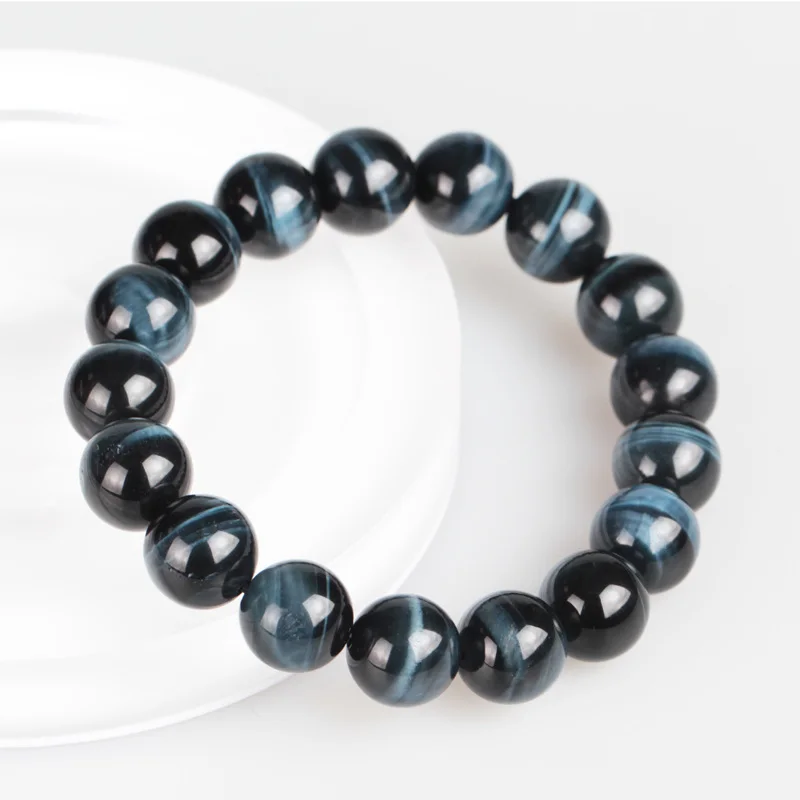
Read the Listing More Carefully Than the Hero Photo
The U.S. Federal Trade Commission advises gemstone buyers to distinguish natural materials from laboratory-created and imitation products and to ask about treatments. A credible tiger eye listing should make its material claim in the product description or specifications-not only in tags or a promotional title.
Look for:
- Material wording: “tiger eye quartz” is more informative than “tiger color” or “cat eye style.”
- Treatment disclosure: dyed, coated, stabilized, reconstructed, or composite material should be described accurately when applicable.
- Multiple views: photos should show the bracelet under ordinary as well as dramatic lighting.
- Actual-item language: determine whether the photos show the exact bracelet, a representative sample, or several selectable variants.
- Seller accountability: a usable return policy and clear contact route matter when natural variation is involved.
If you are comparing currently available designs, use the Tiger Eye Bracelets collection for product-specific photos, prices, and availability. The category is the shopping owner; this guide remains an evaluation resource.
Common Shortcuts That Do Not Prove Authenticity
“The color looks right”
Golden-brown color supports the identification only when it appears with plausible structure and seller disclosure. Color can be edited, dyed, coated, or reproduced in other materials.
“Every bead has a bright cat’s-eye band”
A visible band is relevant, but perfect uniformity can reflect strong studio lighting, selective photography, or a different cat’s-eye material. Ask what the beads are made of.
“It passed a scratch test”
Do not scratch a finished bracelet. The result can be misread, while the test may damage polish, cord, plating, or the surface of another object. It also does not replace professional identification.
“It feels cold or heavy”
Temperature and weight change with bead size, room conditions, metal parts, and construction. Glass and other stone materials can feel similar. These impressions are too broad to settle identity.
Price alone is not proof
Low pricing can justify caution, but a high price is not proof. Price reflects bead diameter, matching, color, polish, construction, branding, and seller margin as well as material.
A Practical Pre-Purchase Checklist
Before ordering, save the listing and check the selected variant—not merely the first gallery image.
- Confirm material wording for the exact size and color you selected.
- Compare close-ups with a full-bracelet view.
- Check whether the listing uses “natural” precisely or as vague marketing language.
- Ask whether color has been altered or the material reconstructed.
- Review bead diameter, bracelet fit, cord or clasp, and metal components separately from gemstone identity.
- Read the return terms for variation, incorrect material, or an item that does not match the photos.
- Keep screenshots and the order confirmation.
For a concrete design reference, the current Tiger Eye Bead Bracelet page shows one specific product’s photos and listing details. It should not be treated as proof of how every tiger eye bracelet must look.
For an explanation of the stone’s broader visual and symbolic context, read the tiger eye bracelet meaning and benefits guide. Do not use symbolic meaning as evidence that a material is genuine.
When Professional Verification Makes Sense
An independent opinion becomes more worthwhile when the bracelet is expensive, the seller makes an unusual origin claim, the material is represented as untreated or collectible, or the purchase matters beyond everyday fashion jewelry. Ask what form of report is supplied, who issued it, and whether it identifies the actual item rather than a generic sample.
A seller-provided card is not automatically an independent laboratory report. Verify the issuer and the scope of the document before treating it as evidence.
FAQ
Can I identify real tiger eye from a photo?
You can judge whether the listing looks plausible and whether it provides useful evidence, but a photo cannot conclusively authenticate the material. Use photographs together with accurate disclosure and seller policies.
Does real tiger eye always have a bright moving band?
Chatoyancy is characteristic, but its visibility changes with lighting, cut, polish, and bead orientation. Some genuine beads show it more strongly than others.
Are treated tiger eye beads fake?
Treatment and imitation are different issues. A treated natural material should be disclosed accurately; an imitation is another material represented for a similar appearance. Do not label every treatment “fake,” but do expect transparent descriptions.
Is a certificate enough?
Only if the document comes from a credible issuer and clearly applies to the item being sold. A generic card or seller-created description should not be treated as independent verification.
What is the safest buying approach?
Choose a seller that names the material clearly, answers treatment questions, provides consistent photos, and offers reasonable recourse. If certainty is essential, seek professional verification rather than relying on destructive home tests.
Bottom Line
A real tiger eye bracelet is best evaluated through converging evidence: plausible chatoyancy and variation, precise listing language, treatment disclosure, consistent photographs, and a seller who stands behind the description. Visual checks help you screen a purchase. They do not replace gemological identification.
Explore more Tiger Eye Bracelet Guides for related meaning, wearing, authenticity, color, and care resources.